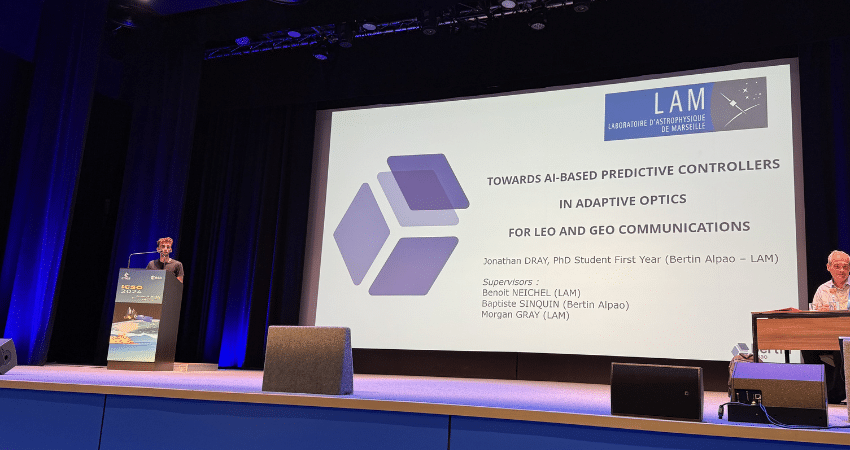


Optical communications are playing an increasingly central role in high-speed data transmission. However, ensuring reliable and lossless reception is a major challenge due to atmospheric disturbances affecting light propagation.
Recognizing this challenge, Jonathan Dray, a second year PhD student at Aix-Marseille University, is exploring the application of machine learning to adaptive optics for free-space optical communications (FSO). His doctoral research, conducted in partnership with the Laboratory of Astrophysics of Marseille (LAM) and Bertin Alpao, aims to develop predictive control algorithms to enhance adaptive optics performance.
Adaptive Optics at the Heart of Free Space Optics (FSO)
Adaptive optics (AO) in ground stations (OGS) has proven to be highly effective in Free Space Optical communication applications and is becoming increasingly widespread. Deformable mirrors, such as those manufactured by Bertin Alpao, enable real-time correction of optical aberrations, improving signal quality between satellites and the Earth. A prime example is the FrOGS ground station in France, developed in partnership with CNES, Airbus Defence and Space, OGS-Technologies and Safran Data Systems, which achieves ultra-high-speed data transmission using adaptive optics.
However, in the case of low Earth orbit (LEO) satellites, operating at altitudes between 160 and 2000 km, several factors complicate signal reception:
- Apparent wind effect:
Due to the high relative velocity between LEO satellites and the ground station, the atmosphere appears to “flow” rapidly across the optical path—this is known as the apparent wind. This effect changes how atmospheric turbulence distorts the light signal, requiring fast and adaptive optical corrections. - Turbulence variations:
As LEO satellites travel across the sky, they pass through different atmospheric regions with varying levels of turbulence. These fluctuations change the distortion of the optical signal over time, making real-time correction using adaptive optics essential for maintaining signal quality. - Scintillation:
When a satellite is at a low elevation angle (near the horizon), its optical signal passes through a longer and denser portion of the atmosphere. This causes rapid changes in light intensity, called scintillation, which degrade image clarity and signal stability. Adaptive optics systems must adjust quickly to mitigate these fluctuations.
Bridging Adaptive Optics and AI for Free Space Optics Communication
Artificial intelligence (AI) is opening new frontiers for optimizing adaptive optics performance, enabling deformable mirrors to anticipate disturbances more effectively.
The first applications of AI in astronomy date back to 2022, when reinforcement learning algorithms were used to aid exoplanet detection. However, these methods were applied in more stable environments with minimal wind effects.
- Improve the robustness of the system with respect to varying alignments and misregistrations between sensors and deformable mirrors
Using predictive control with reinforcement learning (RL) in adaptive optics means the system doesn’t just react to atmospheric distortions in real time—it learns and anticipates them based on past patterns.
Here’s how it works:
- Predictive control uses models to forecast how the atmosphere will distort the optical signal in the near future (e.g., due to satellite motion or turbulence changes), allowing the system to apply corrections before the distortion occurs.
- Reinforcement learning helps the system learn these models over time by interacting with the environment—evaluating how well its predictions and corrections perform, and then improving its strategy through trial and error.
- This approach enables the Real-Time Controller (RTC) to become smarter and more adaptive, especially under rapidly changing or complex conditions like those encountered in LEO satellite communication.
To explore these possibilities, the Laboratory of Astrophysics of Marseille, in partnership with Bertin Alpao, has launched a PhD position dedicated to testing the application of predictive algorithms with AI for Free Space Optics Communication (FSO) .
A PhD at the Intersection of Optics and Machine Learning
Jonathan Dray holds a Master’s degree in Applied Mathematics and Data Science from Aix-Marseille University. He began his PhD on December 1, 2023.
His research is supervised by Benoit Neichel, Head of the Research & Development Group at LAM, and Morgan Gray, Research Engineer in LAM’s Deep Learning division. At Bertin Alpao, he is mentored by Baptiste Sinquin, R&D Engineer in Adaptive Optics.
At the halfway point of his PhD, Jonathan has completed the theoretical phase, which includes an extensive literature review and simulation methodologies. He is now entering the testing phase to validate the algorithms through real-world experiments, both in the lab and on-sky
In June 2024, he published a conference proceeding showcasing his comparative analysis between an AI-based modeling approach and a physics-based predictive model. (Article available here)
In 2026, Jonathan aims at testing his algorithm in real-world at the optical ground station FrOGS, located in the south of France
His research represents a major step forward in the convergence of adaptive optics and Artificial Intelligence (AI), pushing the boundaries of free-space optical communications.
We’re looking forward to share with you the next steps of his studies!